

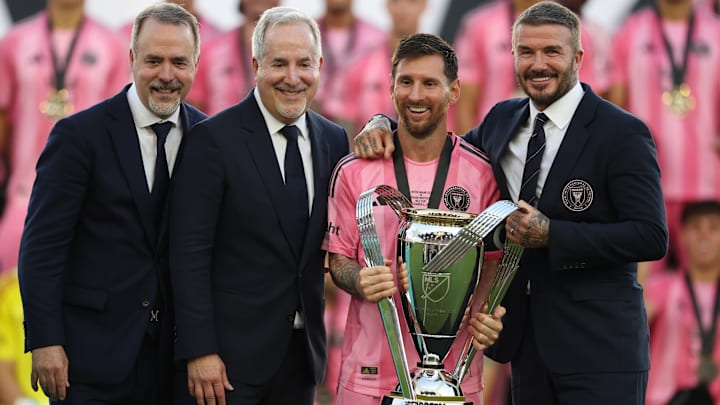
Jorge Mas, one of Inter Miami’s owners, has once again pushed the Copa Libertadores to the center of the conversation by publicly stating that he wants to see his club competing in the tournament in the future. In an interview published by the Argentine newspaper Olé, the executive confirmed he has already spoken with Alejandro Domínguez, president of Conmebol, about the possibility of MLS and Liga MX clubs taking part in the competition. The comments stand out because of their timing and the symbolic weight Inter Miami carries in today’s soccer landscape.
“It’s a dream, and obviously I’ve already had conversations with Conmebol and with Alejandro about our participation in the Libertadores. There are precedents, because in the past Mexican clubs have played in the Libertadores. I want to play in the Libertadores, I’ve already said that publicly,” Jorge Mas said. By pointing to those precedents, he brings back a recent chapter in the tournament’s history and shows that the idea isn’t starting from scratch, but from something that was once tried and later abandoned.
What Jorge Mas is proposing and why it’s back on the table

Mas’ statement doesn’t include dates, formats, or guarantees. What it does is reapply political pressure to an issue Conmebol tried to put to rest years ago. In 2019, Alejandro Domínguez publicly opposed both the return of Mexican clubs and the inclusion of MLS teams in the Libertadores. Seven years later, the sporting and commercial landscape has shifted, and the debate is resurfacing through a club executive who knows how to use exposure and timing to his advantage.
Mas also defended the sporting argument by saying, “I believe the champions of MLS and Liga MX deserve a spot.” He acknowledged that the discussion involves both Conmebol and Concacaf, but argued that the participation of North American and Mexican clubs could help drive the growth of soccer across the hemisphere. The tone is careful, avoiding direct confrontation, yet clear enough to spark reaction.
The Mexican precedent and Inter Miami’s current moment
Between 1998 and 2016, Mexican clubs competed in the Libertadores as invited teams. There was a specific rule in place: if one of them won the tournament, it could not represent Conmebol at the Club World Cup. None ever lifted the trophy, but three reached the final, Cruz Azul in 2001, Chivas in 2010, and Tigres in 2015. Their exit came after Conmebol changed the competition’s calendar, moving the final to the end of the year, which made Mexican participation unworkable.
Inter Miami now enters that context as a new heavyweight. In 2025, the club won the Major League Soccer title for the first time and heads into the new season with bigger ambitions. Messi has already reported back for preseason, and the team is chasing a national repeat and a continental title. Last year, Inter Miami fell in the semifinals of the Concacaf Champions Cup, a result that only reinforced the club’s desire for a tournament with greater sporting and symbolic impact.

Even so, it’s impossible to ignore that Inter Miami’s global profile is also tied to the fact that all eyes are on the club because of Lionel Messi’s influence. That, in itself, isn’t a bad thing. On the contrary, Messi expands reach, fuels global interest, and places MLS at a level of visibility it has never had before. The problem emerges when that exposure starts to be mistaken for structural feasibility. Thinking about any kind of Libertadores integration between Conmebol and Concacaf brings challenges that go far beyond the names on the field.
Time zone gaps, long travel distances, congested calendars, and, most importantly, the impact on fans, especially in Latin America, who would face higher travel and access costs, make the scenario extremely complex. The Libertadores has always been defined by cultural closeness, regional rivalries, and massive fan presence. Altering that balance in the name of commercial expansion may strengthen the product globally, but it also risks weakening the very identity that makes the tournament unique in world soccer.
 Add us as a preferred source on Google